December 3rd, 2017. Nagoya, Toyota Stadium. It’s a gloomy day for Avispa Fukuoka, because Nagoya Grampus just clinched promotion through a dull 0-0, and a disallowed goal from Washington’s header will always be controversial. Still, the hosts can celebrate their return to J1 after one tough season in the second division; meanwhile, Ihara and his players are looking disappointed.
Among the ones on the pitch, there’s a 25-year-old winger on loan from Yokohama F. Marinos. He has started the game, as well as the semi-final against Tokyo Verdy in the play-offs. He hasn’t exactly shone, but Ihara counted on him since he joined mid-season from Yokohama. Now he’s looking to return to Marinos, but his faith wasn’t exactly sealed. He wasn’t granted to stay because he featured in just five league games over three seasons under Erick Mombaerts.
It’s strange to look at that guy back then and think he’s one of the league’s most exciting players today. But when stars align – proper coach, fine system to fit into, new perspectives –, everything becomes possible. That’s why, two years later, Teruhito Nakagawa might even be on the run for the MVP award.
Born and raised in Kanagawa
Class ’92, Nakagawa was actually born in Kanagawa Prefecture, specifically in Kawasaki. And it’s no accident that he flourished through Frontale’s youth ranks between 2005 and 2010, just before joining Senshu University. In those four years, Nakagawa made a name for himself by becoming one of the hot prospects among university players.
In fact, he was part of the Japan national team which came third at the 2013 Summer Universiade. Alongside him, you would have found Shuhei Akasaki, Jun Amano, Jin Izumisawa, Shunsuke Kikuchi, Shintaro Kurumaya, Kazuki Nagasawa and Shogo Taniguchi. So, there was a solid generation of future J. League players in the squad that was defeated by France in the semi-final after penalties.
Nakagawa was tipped to become one of the best rookies in 2015, but a massive injury screwed up what would have been his debut among pros. Instead of old friends, rivals Yokohama F. Marinos signed him, but the forward had to wait to actually play in his maiden year in the J. League. It took him one full year to recover completely, only to debut in September 2015 against Albirex Niigata.
Even there, though, Mombaerts didn’t look sold on the kid. Nakagawa had better chances in the J. League Cup, where you usually field rotation players, but even there he didn’t convince the French manager. Mombaerts could count on figures like captain Manabu Saito, young Keita Endo, veteran Shunsuke Nakamura and talented winger Quenten Martinus. With the passing of time, even Naoki Maeda, Ryosuke Yamanaka, David Babunski and Jun Amano became more and more involved with the starting eleven.
Time on the pitch was limited and so Nakagawa opted twice to leave mid-season on loan for J2 teams. Those two experiences have been different, but they led him here, now and today.
J2 driftin’
The first stop was not that far. In 2016, the winger chose to join Machida Zelvia on loan: the club had just been promoted and had an incredible start to even dream of a playoff spot. Unfortunately, the injury to Koji Suzuki – who back then had scored 12 goals before losing out on the rest of the season – pushed Machida into doing something in the transfer window, and Nakagawa was the choice.
Of course, the Marinos loanee couldn’t play as a no. 9, but they had Yuki Nakashima for that. Nakagawa was mostly used on the flanks, maybe even switching places to be the second striker in Yuki Soma’s 4-4-2. And the manager could anyway pick between him, Kentaro Shigematsu, Tatsuya Yazawa and Yuya Nakamura. It was a wonderful season for Machida, who missed out on the playoffs for a slight detail: goal difference.
In this run, Nakagawa was instrumental because he scored three goals, which resulted in three wins for Zelvia. Among them, the most important one was the 2-1 home win against Matsumoto Yamaga, who probably lost their chance to go immediately back to J1, leaving the door open for Shimizu S-Pulse to overcome them on the table.
After such a good loan, Nakagawa was probably expected to be more involved once he returned to Yokohama. Unfortunately, it didn’t happen, but a former Marinos legend remembered his stint in Machida and opted to sign him on loan mid-season: in Summer ’17, Nakagawa joined Avispa and moved to Fukuoka for a few months at the request of Masami Ihara, this time picking a higher option in the J2 pyramid.
Avispa were relegated from J1 the year before, and the club was determined to clinch another promotion. Unfortunately for Ihara, that group encountered two problems: a) two teams with a better pace than theirs on the table, Shonan Bellmare and V-Varen Nagasaki; b) an ageing group, that was probably at the end of its cycle, which began in 2015 with the promotion to J1 through playoffs.
Despite that, Nakagawa gradually found more space, starting as a backup and then becoming the starter in the 3-4-2-1. Hisashi Jogo, Gilsinho, Riki Matsuda and Daisuke Ishizu were already good options available, but then the Avispa manager was happy to have another card up his sleeve. Despite this, Nakagawa didn’t shine like with Zelvia the season before.
Sure, he was a sure starter in the final part of the season, but he looked like he had hit his ceiling: a high J2-level appearance was the best he could afford back then. And Mombaerts wasn’t going anywhere after four seasons in Yokohama, right? Wrong. After bringing Australia to the 2018 World Cup, Ange Postecoglou resigned and opted to sign for Marinos. And this changed the future of Nakagawa’s career.
Postecoglou, 4-3-3 and magic
The system of Postecoglou is as much interesting as risky: it needed time to develop properly, it needed certain kind of players and a lot of practice. It’s no accident that Marinos almost got relegated last year, and in 2019 they’re fighting for the title (we thought they were lacking a solid GK and a better CB than Thiago Martins; who knows if we have been dreadfully wrong).
In 2018, we’ve seen a lot of things not working with Marinos, but some of them were indeed flourishing under Postecoglou. When he opted for the 4-3-3, the Australian manager knew who to field as a centre-forward (Hugo Vieira), but he had several options on the flanks: Keita Endo, Yun Il-lok, Ippei Shinozuka, Yuki Otsu and Olivier Boumal. Unfortunately, none of them seems consistent enough.
Then Nakagawa returned to the roster after several weeks away. It took him a couple of games to enter the rotation and convince Postecoglou he might be the answer to his never-ending questions. While on the left flank of the forward line, experiments kept going; on the right, Nakagawa found himself comfortable: he ended the season with nine goals in just 24 J1 games (13 goals in all competitions). This made him to be the undisputed starter for the 2019 season.
Meanwhile, despite losing Hugo Vieira at the end of 2018, Postecoglou and Marinos’ board nailed everything in the transfer market session: they got Marcos Júnior from Fluminense (who can play both as a light no. 9 or as a left winger) and Edigar Junio on loan from Bahia. When the latter got injured at the worst time (he had scored 11 goals), Marinos also got his right sub, since Erik – on loan from Palmeiras – has fit well into the system.
What’s the difference with Nakagawa, though? He seems like the only player who can’t be replaced in that forward line. Before the Summer, Marinos could also use Koji Miyoshi and Jun Amano, though both left for Belgian opportunities. Meanwhile, Nakagawa – a natural-born winger who developed skills of a secondary striker under Postecoglou – is a unique piece in this 4-3-3 system with his runs, skills and vision of play.
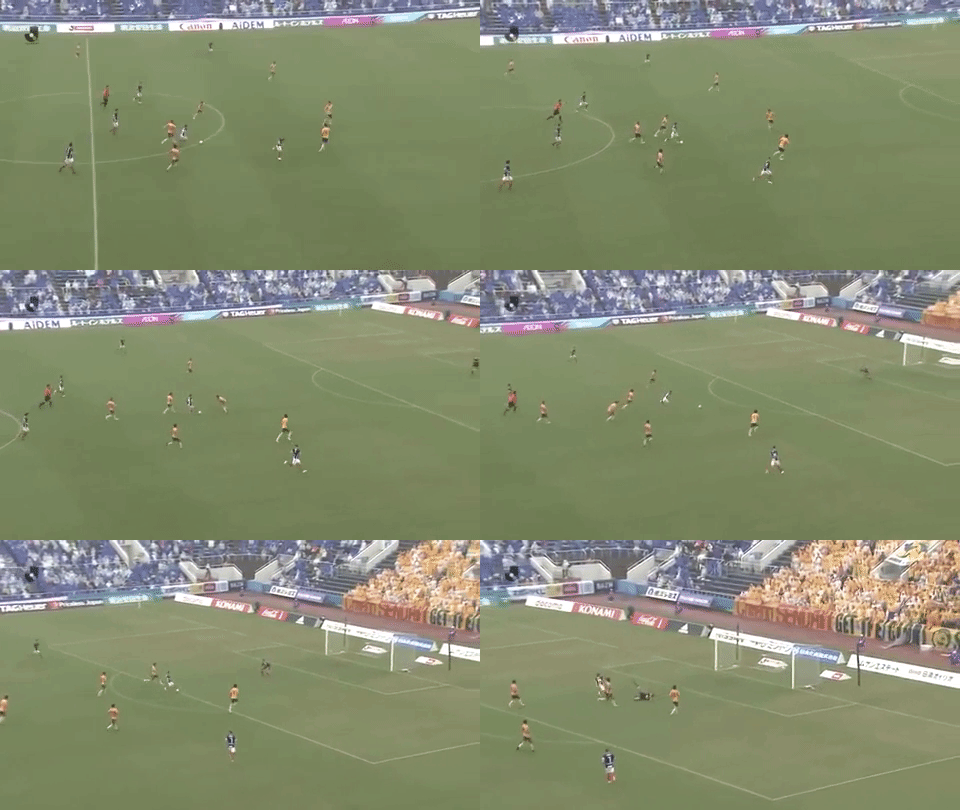
It’s no accident that Nakagawa has collected a wonderful score of stats in 2019: 12 goals, 11 assists, and a MIP award in his pocket. Strangely, Postecoglou gave him his first bench start against Sagan Tosu, but we guess everything is possible. And with a title race on the horizon, we expect Nakagawa to be tested also with the Japan national team: the EAFF Cup is a few weeks away.
Who knows what the future will hold for the Marinos winger? Everything seems possible from now on.

[…] already wrote about him, but the progress of Teruhito Nakagawa might even be surprising for the Marinos winger himself. He […]
[…] might try to add something, but we wrote this piece almost two months ago and it seems still solid to explain why readers vote him for both […]
[…] the Brazilian no. 30 became the main option of a super-attack: while Marcos Júnior and Teruhito Nakagawa were both shining, Junio scored three goals in the opening two games and then collected a wonderful […]
[…] Ienaga had to fail twice in Europe to come back and becoming an elite player in the J.League. Five years after winning the MVP title, Teruhito Nakagawa basically disappeared after leaving Marinos. So it’s not an easy title to […]