Time is funny in life, isn’t it? Someone chases the great opportunity forever and never gets it. Others, instead, tend to have the chance they were waiting for, but just at wrong timing. That’s what must have felt for Rei Hirakawa for a long time – starting from a frosty afternoon in Tokyo. One week before Takefusa Kubo debuts with the U-23 side in J3 League, Hirakawa does the same in a home game against SC Sagamihara.
The game is a success – FC Tokyo U-23 crush the opponents 4-1, with a hat-trick from Yuhei Hayashi and a goal by Makoto Okazaki. On the bench, head coach Tadashi Nakamura can count on just three reserves, including one keeper. At that point, Mao Kobayashi and Rei Hirakawa are free to debut. And Hirakawa actually provides the assist for the hat-trick from Hayashi.
It seems that’s just the beginning. Hirakawa will start in the next game and then… more U-23 pitch time? A loan somewhere? He’s 16 at the time, there’s going be time to grow. Fast forward five years later and Hirakawa hast mostly stayed in Tokyo – with two loans to Kagoshima United FC and Matsumoto Yamaga – but he’s nowhere where high hierarchies probably expected. Kenta Hasegawa doesn’t see him, neither does Albert Puig.
Little did Hirakawa know about his next destination. Leaving mid-2022 for Roasso Kumamoto actually turned to be the choice of his career. Today he’s the captain of the team, a steady hand for the midfield, and the newly-appointed winner of one of the “Regista Awards” in 2023, the one dedicated to the Most Improved Player in the last J2 season.
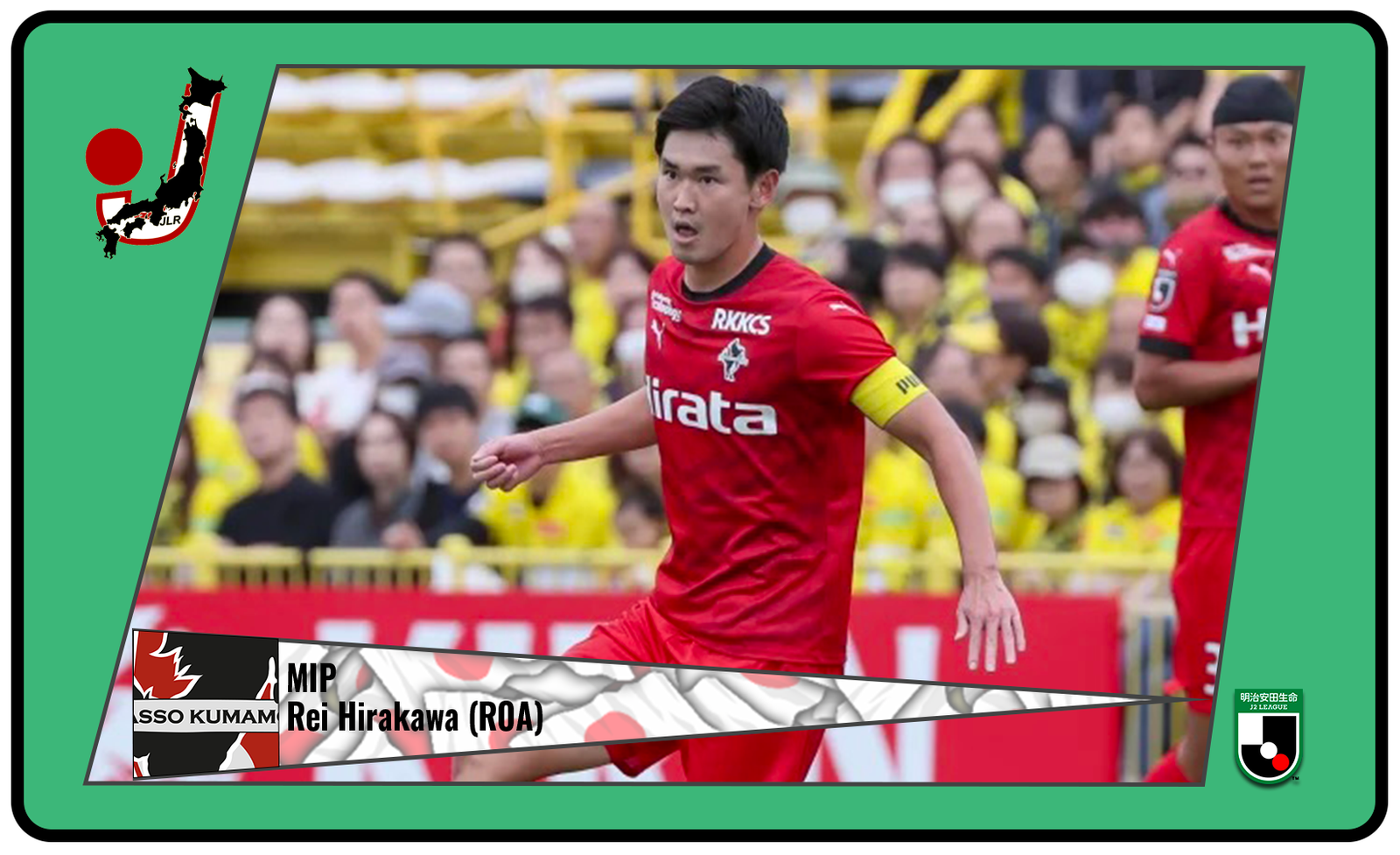
Take and Rei
Born in Chofu – a ward of Tokyo – in 2000, Hirakawa was one of the most decorated youngsters FC Tokyo produced in the last 20 years. He won titles with their youth sector as a protagonist (two U-18 championships). He debuted in J1 in 2017 against Sagan Tosu, at only 17 years old (and he remains in the Top 10 of the youngest ever to play for the club). There were open talks of “Japanese Iniesta” – although that claim looks overstated even now.
Hirakawa built his portfolio through summary appearance for the first team and mostly J3 League minutes. When he debuted in J1, head coach Takayoshi Amma openly admitted “he’s playing well in the third tier, and the players from the first squad are guiding him properly. He also has high expectations. I think he made a good debut”, all before Takefusa Kubo took the stage the successive matchday.
In the meantime, he played as well for the U-17 of Japan, featuring in the 2017 FIFA U-17 World Cup for the Samurai Blue. In that World Cup, Japan were knocked out in the Round of 16, losing to England at penalties (it was a national team with Phil Foden and Jadon Sancho). He was playing with future national team players – such as Kosei Tani, Zion Suzuki, Yukinari Sugawara, Keito Nakamura, and (of course) Takefusa Kubo.
But even other teammates from that experience had an easier ride than him after 2017. Taisei Miyashiro, Koki Saito, Toichi Suzuki, Yuki Kobayashi, and Togo Umeda didn’t make it to the Samurai Blue, but surely had a nice J.League rise. Instead, Hirakawa kept chumping small chunks of pitch time, which wasn’t helpful to grow.
No prophet in his land
Unfortunately, neither Hirakawa showed the leap needed in terms of quality, nor any head coach at FC Tokyo wanted to give him more minutes. When the U-23 team folded from J3, Hirakawa found himself with almost no minutes. He played four minutes in J1 in 2018 against Kashiwa Reysol, then one (!) in 2019 before being loaned, then seven in 2020, and in the end none in 2022.
A loan would have made the difference, but both experiences outside of the capital didn’t make any difference. And unfortunately, Hirakawa has been loaned both times to a team relegated from J2. First, Kagoshima United FC – a loan that came mid-2019 to give him minutes at a higher level to a team who desperately needed some creativity in the midfield to avoid relegation back to J3.
Hirakawa started being involved, then got injured in September against Kyoto Sanga, and never returned. Kagoshima were holding for their life, but got relegated in the last matchday. Back to Tokyo then, where he saw basically no minutes in 2020, to then another loan – always in J2, always with a struggling side. This time, Matsumoto Yamaga and a crumbling side.
Hirakawa got into the rotations, then got injured for two months, then saw another managerial change – out Kei Shibata, in Hiroshi Nanami. It didn’t work – Hirakawa played indeed more, but in a strongly-defensive side, who didn’t manage to create enough despite a huge payroll and several J1 former players. In the end, he got dropped in the most critical point and got back to Tokyo to not play. Again.
Away to shine
In June 2022, Hirakawa wasn’t playing in Tokyo. At all, he was rarely on the bench, and started just once in J.League Cup – despite having already six seasons under his belt at just 22. It couldn’t go on like this, so Hirakawa decided to leave once it for all. His next move was the right one: Roasso Kumamoto. Takeshi Oki proved already to be an alchemist – especially with toys that look broken.
Hirakawa says himself once presented on the website: “I’m happy to be part of a club which plays very attractive soccer”. Hirakawa gets immediately integrated, playing behind the lone striker. He seems another player, and he becomes fundamental to the point that one shot in the 94th minute of the play-off against Kyoto Sanga ends up on the post, denying Roasso their first J1 season. In the 3-3-1-3 from Oki, the “1” is pretty important. He’s the only one not replaceable.
And Oki frames that with the choice of making Hirakawa the captain of Roasso for 2023: “I want to have a fun season, not a nervous one. Let’s have fun together”. And Hirakawa helped keeping that promise – Roasso didn’t fly as high as in 2022, but they reached the semifinal of the Emperor’s Cup, in which Hirakawa scored a historical goal to win the tie away in the Round of 16, and one in Kobe to overcome Vissel (plus the decisive PK).
Hirakawa played 41 matches in J2 League this season, bringing seven goals and nine assist on the table. He led a side not capable of reaching the heights from last year, but rather capable of surprising us again. Oki saw something, and it wasn’t difficult to understand why. It’ll be up to Hirakawa to prove this wasn’t a fluke after years of frustration.
[…] was one of the names to watch, after taking over the armband at Roasso Kumamoto. We explained here why he deserved the MIP award this […]
[…] wouldn’t stay too much on him – we literally wrote an article last November to talk about him after the readers elected him “MIP” of the J2 League. His numbers with Roasso […]